What is a cob?

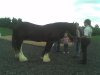
I also agree with DD that none of the horses posted so far on this thread (with the exception of the horse above) are true cob types. ETA Just spotted LR's cob and the little grey, I think the main difference is the little grey is LW and Draco is HW.

It's interesting you say that, as the Chestnut in the same post as the first photo of Draco beat your horse (Luke) a few years ago, and went on to beat on of Lynn Russel's in the championship ;) (I like Luke very much though, a lovely horse).

I'm a panel judge for the British Show Horse Association (which has just changed from being the British Show Hack, Cob and Riding Horse Association), and see a lot of small hunter types hogged and shown as cobs. Infact in my assessment for the judging panel I was asked about just that, and how I would deal with it in placing horses.

As a showing person, ofcourse I love a good show cob, but I can appreciate there are lots of other types of cob out there who are equally justified in being called 'cobs', but wouldn't do well in a 'cob' class at a show, where show cobs will predominate.

On the issue of weight, it is still a big (no pun intended) problem in the showing world. Putting fat on a horse gives the appearance of substance and can mask a multitude of conformation faults. I've placed horses down the line for being overweight, and have myself been told that my horse was overweight while showing (I'd just bought him, he was overweight and was on a strict diet at the time already!). Draco was overweight in that picture, possibly because he's been shown as a lightweight cob for several seasons, then last year she decided to bring him out as a heavyweight, perhaps thinking that increased weight would give the illusion he was 'bigger about'. He didn't do half as well last year as he had done as a lightweight.

This is the horse I qualified for HOYS in 2005 - In my opinion he was too light of bone for his frame (he was shown as a lightweight), but still a cob type

machoys.jpg
 
he's been shown as a lightweight cob for several seasons, then last year she decided to bring him out as a heavyweight, perhaps thinking that increased weight would give the illusion he was 'bigger about'.
I thought it was all about bone (and build as a secondary consideration)? How could he have the correct amount of bone to show as both a lightweight and a heavyweight?
I know Im diversifying from cobs here, but my horse has 9 and a half inches of bone and is about 17hh, so is the top end of a middleweight show hunter. Surely I wouldnt be able to get away with getting him skinny and showing as a lightweight, and clapping some pounds on him and showing as a heavyweight?! I know you said the horse hasnt been doing as well but do horses that dont meet the requirements not get removed from classes - like ponies that get measured out etc?

Although I have just thought of a way round it as I typed ;). Because the minimum bone requirement for a class might be, say, 9 inches, does that mean that if you have a horse who looks the part for that class, but has 11 inches, you could show him in it? Because theres no maximum bone limit? And then when he fattens up you could move him up?


xxx
 
Re: Jojoba - There isn't an exact requirement for the amount of bone, unlike the height limit, which is enforcable. No-one will come round measuring the amount of bone your horse has, it's up to the judge to decide whether the horse has an acceptable amount of bone for that class, and to weigh that up in his/her mind against the other good and bad parts of that horse's conformation and performance, and against the other horses in the class. Hence some judges cannot abide a cob that's light of bone and it'll go straight to the bottom of the line, while others will say 'well it was light of bone, but gave me the best comfortable ride in the class and is a cob in every other way...' the same can be said for lots of conformation preferences.

Lightweight and heavyweight cobs are as much split on substance through the body as they are on bone, and you'll get the inevitabe few that are right in the middle and could either go in either category or look out of place in either category. The LWs as a whole tend to have better movement and more quality about them, although the best HWs are full of quality, with movement to match. I think to really appreciate the difference between LW and HW you need to see a few classes at the major county shows or championships, it's not easy to describe! A good judge will spot a hunter fattened up to look like a LW or a LW fattened up to try to look like a HW (which can happen as the LW classes usually have more in the classes and a better quality of horse!)

With the British Show Horse Association classes you have to declare whether you are showing your horse as a LW or a HW at the beginning of the season, but you can move categories from season to season (though I believe there is a limit to the number of times you can change).
 
It's interesting you say that, as the Chestnut in the same post as the first photo of Draco beat your horse (Luke) a few years ago, and went on to beat on of Lynn Russel's in the championship ;) (I like Luke very much though, a lovely horse).

:) Skipped through - long thread. I remember the chestnut, very nice cob. Of course I include him in that bracket (just missed him in the first instance!)
 
ok ok ,so im totally confused!!!! i thought a cob was a cob,but now i see lot's of variations,so my lad has 10 1/2" bone and is 3yrs old,he is welsh sec D x irish cob and stands approx 14.3hh at the moment,he's definately not show cob i see that (wouldn't want him to be either) ,is he cob "type" then or just a traditional ? heres a pic.he's leaning forward for a mint.
 

Attachments

  • Image005.jpg
    Image005.jpg
    19.1 KB · Views: 14
The term 'cob' so overly used now eh?

When we brought our first horse she was described as an irish sports horse (another bag or worms!) and a horsey friend of mine said 'oh, shes a bit cobby isnt she?!'.

Cobby being used to describe a horse thats not 'fine' with a tiny bit of feather.

I think anything thats not 'fine' is considered a cob these days just out of laziness!

Great piccies, they are all gorgeous!! When I have the time and am feeling a bit techy I will post a piccy of my 'bit cobby, irish sports horse'!!!!!!!!:o:rolleyes::D
 
Littleme - that's a cob ;)

Coyote - hard to tell from the photo, but I think cob type rather than cob, and traditionals are coloured. He ought to do reasonably well in cob type classes if you don't already do them.
 
Here is my Cob "Spike". I enter him in the cob classes and working hunter classes too where the judges seem to like him, although he can be pretty slow sometimes and they do like the cobs to be forward going but safe. I would say he was a classic mw cob.


P02-05-07_07.jpg
supersexyspike-1.jpg

100_0640.jpg
P20-05-07_15-3.jpg

P20-05-07_15-4.jpg
P20-05-07_15-1.jpg
 
The cob is a short-legged 'stuffy' type of small horse, stocky in apperance and capeable of carrying a heavyweight rider. Its kind, unflappable, willing nature and impeccable manners, coupled with it's weight-carrying ability, make it and ideal mount for a heavyweight elderly rider - or indeed for anyone who is not particularly athlectic.

As with the hunter, there is no set formula for breeding a cob. Many of these are produced by chance, although, Irish Draught blood is often used with great success, particilarly when mixed with thoroughbred. The cob's sturdy, muscular proportions are not designed for great speed, but it should none the less have active paces and be able to gallop and jump well.

At one time the cob was used as an all-purpose horse, preforming equally well in harness and under saddle. Nowadays it is often seen as a riding horse - the best make excellent hunters. Under British Show Hack and Cob Asscosiation rules, cobs are exhibited to weight classes: as lightweights, capable of carrying up to 14 stone and as heavyweights capeable of carrying over 14 stone. There are also working cob classes, in which horses must jump a workng hunter-type course of fences.

The cob's mane is traditionally hogged. It used to be the custom to dock the tail of cobs but cruel practice was made illegal in britail inder the Docking and Nicking Act, 1948.

Height:
Up to about 15.3hh (in show classes not over 15.1hh)
Colour:
Any
Conformation:
Intelligent looking head, woth no suggestion for coarseness; fairly showt, arched neck; strong, sloping shoulders; broad, deep body with short back and powerful loins; strong well-muscled hindquarters; short, strong limbs with plenty of bone; broad, open feet.

Taken from: The Ulitmate book of horse and rider by: judith draper, debby sly and sarah muir . p.g. 181
 
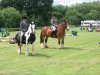
So any points of view on my naughty boy!!he is an irish cob 14.2 and very very heavywieght, should i hog or not?if i keep the hair he could show as traditional but.... dont they have to be coloured?
not mountain and moorland as irish cob not classed as true breed.
This was his first visit to a show, and he was a good boy, he only planted twice!!

scotch gnosall show 07 039.jpg

mine is the bay and thats my freinds daughter riding-not me!!
 
I've always called Barney a gyspy cob, as have his owners (I have him on loan). We call him TGC, not Traditional Gyspy Cob though...Tinky Gyspy Cob coz hew gets himself in such a mess!

We only do jumping so I've never bothered about what catagory he fits in!

poser.jpg


jump.jpg


hairy.jpg
 
newrider.com