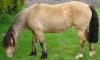
I imagine it's because people will always go on the phenotype, as genotypes are not necessarily going to be known. Therefore a horse that looks dun is going to be called dun - whether it actually is dun or not is largely irrelevant in the grand scheme of things!
Exactly. And unless you know what to look for, visually bay duns and buckskins can be remarkably similar.
It would probably be much simpler if the colour "dun" was just "dun", and the dun and buckskin genes referred to as DU1 and DU2, or suchlike.
Except that the dun gene and the cream gene do already have names... so just lumping anything under 'dun' because of the phenotype doesn't neccessarily stop the confusion. Especially when the 'buckskin' gene is cream; which is also responsible for palomino and smoky black in heterozygous form, and perlino, cremello and smoky cream in homozygous form!
I've noticed lots of people starting to call coloured horses "tobiano" lately - I've only got a very vague idea of what this means. Plus lots of adverts referring to "chestnut and white" or "bay and white" - why not just say skewbald?

Tobiano is a particular coat pattern - the one seen most commonly in gypsy cobs and vanners, some paint horses, Shetlands and so on.
Chev, is there a good website listing the colour genes in horses, and their various combinations to produce different phenotypes? I'd be really interested to look this stuff up and work out some colour combinations for myself!
I will have a look through my bookmarks and post a few...

And another one for chev - is casper's photo of a dun or a buckskin?! I confess I can't tell the difference (is there a difference in phenotype anyway, or is it just a difference in genotype?).
She's a difficult one; based on the very black lower legs, golden body colour, and lack of any other dun markings, I'd say buckskin. She does have very reduced black on her legs; but she's bay-based, and I'd think that she's probably 'wild type bay' - a particular variant of bay that does cause reduced pigmentation at the points. Duns nearly always have other factors; one being a darker face where colour is less dilute (Capser's mare doesn't have that), shoulder stripes, leg barring, clear dorsal stripe of undiluted body colour (not darker than body colour, although genes like sooty can interfere with that). They can also have cobwebbing stripes on the head, although that's not as common as other factors. The biggest difference is the way colour is diluted though - dun gives a very flat, washed-out look, whereas cream gives a golden shade. There is a fantastic site dedicated to duns which I'll find for you now - it explains the differences between buckskins and duns really well, also gives some great examples of 'false duns' (horses that look dun when they're not), tips for recognisisng duns, and has lots of pictures!
Arrrgh, and then you get explanations like this:
http://en.wikipedia.org/wiki/Bay_(color) (scroll down to the explanations of colour) - where they say that a horse "lacks the Agouti gene", when their diagram clearly shows that the horse does NOT lack the gene, it just carries the recessive allele! I wish people writing explanations like that would be a little more accurate, no wonder people get confused!

Unfortunately sometimes being more accurate actually just confuses more people... in fact all horses carry two copies of every single colour and pattern gene. There is only one *colour* gene; the extension gene. If a horse carries the allele that allows black pigment to be produced, it'll be black. If it doesn't, it's be red. Every other gene simply controls how that pigment is expressed... and it's not the genes that control that, it's the alleles. Alleles being the codes carried within a gene that control how cells develop (and in the case of colour, how pigment is produced and expressed visually).
So every horse on teh planet has two Agouti genes; it's not the genes that matter, but the codes they carry... the alleles.
Oh just to add the connemara socity register dun only !!
Casper - I suspected that was the case. Which basically means every buckskin Connemara in existance is registered as 'dun' - and therefore identified and advertised as such, in spite of the fact that they don't carry dun!


 He's just got the added darkening seen with sooty which confuses the issue. There is no dun gene in Connemaras.